Transmitter safety
What the firmware does to keep the transmitter quiet, what it cannot protect
against, and the rules a transmitting program must follow. For the four rules
to follow before you cable anything, see
before you transmit. The evidence is in
IDLE-CASES.md and tools/IDLE-CASES.md;
the short version is in the README.
The numbers that matter
- Transmit output, flat out: about +19 dBm (an estimate capped at the PA's compression point; never metered)
- Receiver absolute-maximum input: +2.5 dBm, about 16 dB below what the transmitter puts out
- Attenuation in any TX→RX loopback: at least 20 dB
- Every power-on: a ~4 ms burst on both transmit ports, before any software runs
- Opening a transmit buffer: can raise output by itself: 28.25 dB measured, from a muted board
| Term | Meaning |
|---|---|
| TX / RX | transmit / receive |
| Attenuation | turns the transmit output down, from 0 dB (full power) to −89.75 dB (the floor, "muted") |
| DMA buffer | the block of samples a program hands the kernel to send; opening one starts a transmit stream |
| cyclic buffer | one block the hardware repeats forever |
| TX LO | the transmit local oscillator |
| debugfs | the kernel's debug file interface under /sys/kernel/debug |
Before you transmit
| Rule | Why, and where it is explained |
|---|---|
| Terminate every transmit port | never transmit at power into an open one: the power budget |
| Fit at least 20 dB of attenuation in any TX→RX loopback | the receiver's absolute maximum input is +2.5 dBm; the transmitter reaches about +19 dBm |
| Take the antenna off any transmit port you do not want radiating when the board powers up | every power-on emits a few milliseconds at the TX LO on both ports, and no software can prevent it: details |
| Affirm the channel you will raise, after looking at that port | ./devkit tx-guard affirm 0 for TX1A, 1 for TX2A: details |
| Know which target the board runs | grep ^ID= /etc/os-release on the board: Debian is the modern target, Buildroot the factory one. The protections differ |
On the factory kernel, re-mute after any debugfs initialize |
and read both attenuations back: why |
| Set TX attenuation after the buffer starts, and read it back; mute before tearing the buffer down | why |
| Never flash with DFU | see flashing |
A TX→RX loopback without an attenuator will destroy your receiver
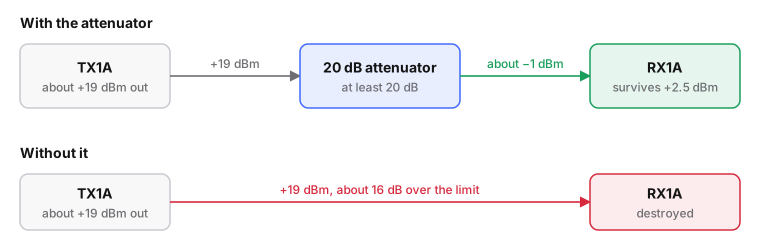
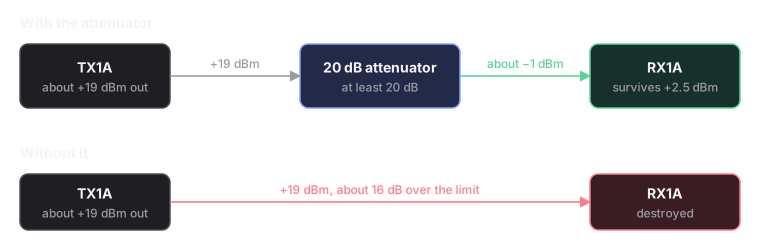
+2.5 dBm is the AD9361's absolute-maximum RF input
This board is sold in a variant with a Mini-Circuits PGA-102+ power amplifier on transmit (its gain is below), with P1dB (1 dB compression point) around +17.5 dBm. Plan for about +19 dBm flat out, roughly 16 dB above what its own receive port survives. That is the self-test's estimate, capped at the compression point; no power meter has measured it. The non-PA variant is 10–18 dB quieter; check which you have.
PGA-102+ gain:
| GHz | 0.05 | 0.8 | 2.0 | 3.0 | 4.0 | 6.0 |
|---|---|---|---|---|---|---|
| Gain (dB) | 17.7 | 15.9 | 14.0 | 12.5 | 11.5 | 10.4 |
| Rule | Why |
|---|---|
| Do not transmit at power into an unterminated port | neither the AD9361 datasheet (TX into a matched 100 Ω load, ~6.5 dBm max) nor the PGA-102+ datasheet states a tolerance for an open, a short or high VSWR |
| Fit at least 20 dB of attenuation in any loopback | the receiver's +2.5 dBm limit |
| Measure through exactly 20 dB | with 50 dB the board's internal TX→RX leak is as strong as the loop above about 1.5 GHz (details) |
| Start at maximum attenuation and raise power in steps | tools/selftest/ never transmits with less than 35 dB of its own attenuation |
This table and these figures are the canonical copy; tools/selftest/README.md
and the agent skill point here. Update them here first.
What the firmware protects, per target
| protection | factory target (5.15, Buildroot) | modern target (6.12, Debian) | limit |
|---|---|---|---|
| probe at maximum attenuation | yes (patches/0011) |
yes (its device tree) | applied after the power-on calibration, which has already transmitted |
| mute at boot, before anything can stream | tx_quiesce in S21misc |
fishball-rf-quiesce.service; iiod does not start unless it succeeded |
fw_setenv tx_quiesce 0 turns it off |
| mute when a stream stops | yes (0004, 0005) |
yes | fires on buffer teardown only |
| mute when the DAC starves (a killed or stalled program) | yes (0015), 250 ms |
yes, 250 ms | exempts cyclic streams; fires once |
| bound on a cyclic stream | off (tx_cyclic_timeout_ms = 0) |
60 s, armed at every boot | off on the factory target unless you set it each boot |
| TX-disable latch | yes (0016), off by default |
yes, off by default | root can clear it |
| die-temperature ceiling | yes (0018), off by default |
yes, off by default | |
| a cached attenuation of zero is never restored | no: debugfs initialize can key full output |
yes (firmware-modern/patches/0019) |
Stock firmware has none of these
At power-on the AD9361 comes up in ENSM fdd (its state machine, both chains
powered) with the TX synthesiser running and only 10 dB of attenuation, so the
port emits LO leakage continuously.
The examples use iio:device0 for ad9361-phy and iio:device2 for
cf-ad9361-dds-core-lpc (the transmit DMA device), as the modern target numbers
them. The numbers are not guaranteed across kernels; in a script, find each
device by its name file:
# run from: the board
for d in /sys/bus/iio/devices/iio:device*; do echo "$d $(cat $d/name)"; done
Muting when a stream stops
patches/0004 calls ADI's ad9361_tx_mute() from the TX buffer lifecycle:
| event | what happens |
|---|---|
| boot | TX at maximum attenuation from the device tree, but not from the instant power is applied (why). The boot mute is fishball-rf-quiesce on Debian and S21misc on Buildroot |
| a TX buffer starts streaming | TX unmuted: your gain if you set one, else the last you used |
| the buffer stops | TX muted and the synthesiser powered down |
The unmute restores the cached attenuation only if nothing has been set since the
mute (patches/0005): set a gain then start the stream, and you get the gain you
set; start with nothing set, and you get the last gain used.
Remove any watchdog script that polls buffer/enable to re-apply a gain
On a board with a power amplifier it applies a fixed gain to both channels a second or two after any stream starts.
| Where to look | |
|---|---|
| Buildroot | /mnt/jffs2/autorun.sh first: it survives reflashing and appears nowhere in the source |
| Debian | nothing runs autorun.sh; look at systemctl list-units 'fishball*' and systemctl --failed |
| either | tools/selftest/sdr_selftest.py --ssh reports what is in /mnt/jffs2 and whether anything would run it |
When the program dies: the starve watchdog
Kill a program that is transmitting from the board itself and buffer/enable
stays 1: teardown never runs, so the stream-stop mute never fires.
patches/0015 mutes instead when no data reaches the DAC for 250 ms while the
transmitter is on: a killed program, a stalled one, or a buffer enabled and never
fed.
| Measured | Time to −89.75 dB |
|---|---|
a killed local transmitter, both kernels (tools/IDLE-CASES.md, case B) |
0.26–0.27 s |
a killed streaming transmitter, with 0022 |
280 ms |
a buffer enabled and never fed (64 KB block), with 0022 |
315 ms |
# run from: the board - how long the DAC may starve before muting, 0 disables
cat /sys/bus/iio/devices/iio:device2/tx_starve_timeout_ms
fw_setenv tx_starve_ms 1000   # a different timeout, from the next boot on (20 ms minimum)
fw_setenv tx_starve_ms 0      # no starve mute, from the next boot on
fw_setenv tx_starve_ms        # back to the default
A large first block gets time to arrive (patches/0022). A buffer is
enabled before its data is uploaded, so the first wait is 250 ms plus the time
to upload one block at 1 MB/s, capped at 10 s. After the first block, 250 ms
applies as before. Two channels at 40, 50 and 60 MS/s ran unmuted.
Without 0022 |
|
|---|---|
| symptom | silence plus a DMA underflow |
| cause | a 4.4 MB cyclic buffer (two channels at 40 MS/s) was muted before it landed, and the mute also switches the DAC away from the DMA |
It exempts cyclic streams, and it fires once (both below).
Cyclic transmits and the 60 s bound
A cyclic stream outlives the program that started it by design, so the starve
watchdog leaves it alone. Every streaming tool in this devkit transmits
cyclically. A separate bound, tx_cyclic_timeout_ms, covers it; the kernel's
compiled-in default is 0, off.
| Target | Bound |
|---|---|
| Modern (Debian root) | armed at 60 s on every boot. fishball-rf-quiesce writes it before iiod starts, and iiod does not start unless that unit succeeded (Requires=). The board stays reachable over usb0; see the Debian root reference. After a cold boot tx_cyclic_timeout_ms reads 60000 |
| Factory (Buildroot ramdisk) | not armed, unless you set fw_setenv tx_cyclic_bound <ms>, which S21misc applies at every boot (patches/0023) |
# run from: the board - check it, change it, or turn it off
cat /sys/bus/iio/devices/iio:device2/tx_cyclic_timeout_ms   # 60000 after boot (Debian)
echo 10000 > /sys/bus/iio/devices/iio:device2/tx_cyclic_timeout_ms   # this boot only
fw_setenv tx_cyclic_bound 10000    # a different bound, from the next boot on
fw_setenv tx_cyclic_bound 0        # no bound at all, from the next boot on
- The timer is armed when the block is submitted, so it also mutes a healthy, unattended cyclic transmit 60 s after it started.
tx_cyclic_boundis separate fromtx_quiesce, so turning off the boot mute does not also unbound every cyclic transmit.tools/sample_gpio_clock.pyholds a cyclic stream until Ctrl-C: its RF goes quiet after 60 s, its pins do not, and it prints the bound at start.
The starve watchdog fires once
It does not re-arm. After a starve-mute a gain write raises the attenuator and nothing re-mutes it until a fresh buffer enable:
atten0=-30.000000 LO_pd=1 buf=1 (gain written AFTER the watchdog fired)
Never judge hardwaregain alone
What keeps that port silent is the powered-down TX LO, not the attenuator.
Read out_altvoltage1_TX_LO_powerdown beside it.
Refusing to transmit at all
# run from: the board
echo 1 > /sys/bus/iio/devices/iio:device0/tx_disable
A latch that forces maximum attenuation and cannot be cleared by debugfs
(initialize, or bist_tone mode 1), both reachable over port 30431 (iiod,
no authentication). A root write to the same file clears it, and it reads 0
unless somebody sets it.
Refusing to transmit when hot
# run from: the board - millidegrees C; 0 (the default) disables it
echo 60000 > /sys/bus/iio/devices/iio:device0/tx_temp_limit
Above it, requests to get louder are refused and logged; muting never is. Armed below the die temperature, it makes transmit code testable with an antenna on:
# run from: the board - 1 C, so nothing can ever get louder
echo 1000 > /sys/bus/iio/devices/iio:device0/tx_temp_limit
dmesg | tail -1
# ad9361 spi0.0: die at 40.351 C is over the 1.000 C transmit limit - staying muted
Prove the gate is live
Make an explicit -60 dB write first: an empty log proves nothing if nothing was armed.
Raising output needs a human on record
Nothing on the board can tell what is attached to a transmit port, so the devkit records what a person says, per channel (0 is TX1A, 1 is TX2A), and refuses to raise that channel without it.
# run from: the repo root
./devkit tx-guard affirm 0        # only after LOOKING at TX1A
./devkit tx-guard check 0         # exit 0 affirmed, 3 not
./devkit tx-guard revoke both     # withdraw, and force maximum attenuation
The same gate, with the same commands and exit codes. It needs paramiko,
in a venv, and logs in with the board key from ./devkit ssh-key if there
is one, else the root password:
# run from: the repo root, in cmd or PowerShell (on Linux or macOS: .venv/bin/ in place of .venv\Scripts\)
python -m venv .venv
.venv\Scripts\pip install paramiko
.venv\Scripts\python tools/tx_gate.py affirm 0
.venv\Scripts\python tools/tx_gate.py status
tools/tx_gate.py picks this route by itself on Windows, so a script that
imports it (as sample_gpio_clock.py does) works there too.
| where the record lives | the board's /tmp (RAM): a reboot withdraws it |
| refuse without it | ./devkit selftest --loopback, tools/sample_gpio_clock.py, tools/modulation-gallery/board.py, the automation server's Transmit and TransmitCapture |
| checked, not gated (they never command output) | ./devkit selftest alone, ./devkit gpio-check |
| muting | never gated |
| one affirmation covers | one run: the harnesses in tools/tx-idle-cases/ call tx-guard.sh revoke both on exit |
This raises the floor; it is not a lock
A direct write to out_voltageN_hardwaregain walks past it, and the
affirmation file can be forged by any process. The mute costs no output power:
over a 50 dB loopback, commanded and applied attenuation matched to 0.01 dB at
every point including 0 dB.
What the firmware does not protect against
Every power-on transmits, and no software here can stop it
Do not leave an antenna on a transmit port you do not want radiating when the board is powered up
About one second after power is applied, both TX1A and TX2A emit a narrowband burst of roughly 4 ms at the transmit LO frequency.
| level | around 50 dB above two control bands 1.0 and 3.0 MHz below it; it saturated the receiver through 20 dB, so this is a lower bound, equivalent to at least −20 dB of commanded attenuation |
| captured on | a separate HackRF One through a pad (the board's own receiver powers up with it and cannot see it) |
| band, duty | the 2.4 GHz ISM band, negligible duty cycle |
| cause | normal AD9361 behaviour: ad9361_tx_quad_calib() drives a test tone through the transmit path to correct I/Q imbalance, at ad9361.c:5308, before ad9361_set_tx_atten() applies the device tree's value at :5326. The PGA-102+ amplifier is what makes it loud here |
| why nothing helps | tx_quiesce, the affirmation gate, the starve watchdog and tx_disable all act too late, so the mitigation is operational |
Measurements: IDLE-CASES.md.
Opening a transmit buffer is not a neutral act
The unmute restores whatever gain the last stream used, on a bare buffer enable, with nothing having asked for output. On a board fully muted:
before anything                 atten0=-89.750000  LO_pd=1  buf=0
after a bare buffer enable      atten0=-61.500000  LO_pd=0  buf=1
A 28.25 dB raise, bounded only by the loudest gain used since boot. Two rules follow:
Two rules for every program that streams
- Write your attenuation after the buffer starts, and read it back. Anything written before the enable is what the restore overwrites.
- Mute before you tear the buffer down, never after. The stream-stop hook
caches whatever attenuation it finds before applying maximum, so closing first
hands your gain to whoever streams next.
tools/tx-guard.sh'sreapfollows the same ordering.
A program meant to stay silent while streaming must read both attenuators right
after the enable and stop if either moved. All four of the devkit's streaming
tools do (tools/tx_gate.py:assert_quiet_after_enable); an unreadable attenuator
counts as a failure.
debugfs initialize on the factory kernel
On the factory kernel, debugfs initialize wipes the cached attenuation to zero,
and zero attenuation is full output:
# run from: the board. On the factory kernel, with an antenna fitted, do NOT.
echo 1 > /sys/kernel/debug/iio/iio:device0/initialize
# ...then anything at all that opens a transmit buffer...
leaves the transmitter keyed flat out (TX2 read 0.000000 dB on hardware).
| Target | Fix |
|---|---|
| modern | firmware-modern/patches/0019 seeds the cache with maximum attenuation |
| factory | re-mute after any initialize and read both attenuations back, below |
# run from: your HOST
U=ip:192.168.2.1
for c in 0 1; do iio_attr -u $U -c -o ad9361-phy voltage$c hardwaregain; done
Rules for programs that transmit
A mute you did not read back is not a mute
A write to out_voltageN_hardwaregain can fail, and 2>/dev/null or
except Exception: pass hides it. Every mute in this repo writes, reads back,
compares against −89.75 dB, and says TREAT THAT PORT AS LIVE when they
disagree. A caller that discards a pass/fail return value moves the silent
failure one level up.
Shell scripts that run on the board:
| Rule | Why |
|---|---|
Trap HUP, not just EXIT INT TERM |
a dropped ssh session delivers HUP; untrapped, the script dies and leaves running whatever it started (for tools/tx-idle-cases/dds-tone.sh, a DDS tone that neither 0004 nor 0015 can reach) |
| Install one handler | trap replaces, it does not append |
| Mute before you tear the buffer down, on the error paths too | the stream-stop hook caches the gain it finds |
The handler must exit |
a trapped signal does NOT terminate the shell: execution resumes at the next statement, which in a harness can open a TX buffer and restore the previous stream's gain after the operator has gone |
Mask the signals as the handler's first statement (trap '' INT TERM HUP PIPE QUIT) |
with PIPE trapped on a dead stdout, every echo re-enters it |
Do not rely on QUIT |
QUIT does not fire under dash, and over ssh host "sh script" with no pty, Ctrl-C arrives as HUP and PIPE, not INT |
No nohup |
nohup silently drops the HUP handler (a signal ignored on entry cannot be trapped). Run such scripts in the foreground, or follow with an explicit off |
Shape the traps like this:
# run from: the board
trap '_quiet_on_exit' EXIT
trap '_quiet_on_exit; trap - EXIT; exit 130' INT          # (1)!
trap '_quiet_on_exit; trap - EXIT; exit 143' TERM HUP PIPE QUIT
- Each handler mutes, clears the
EXITtrap so the mute does not run twice, and exits: a trapped signal alone does not end the shell.