Choose where your code runs
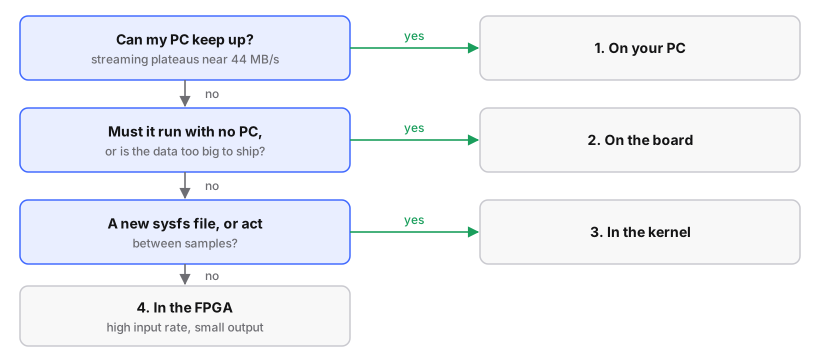
Most projects belong on your PC. Ask these in order and stop at the first yes:
| # | Question | If yes |
|---|---|---|
| 1 | Can my PC keep up? Streaming over gigabit Ethernet plateaus near 44 MB/s | on your PC |
| 2 | Must it run with no PC, or is the data too big to ship? | on the board, on the Debian root |
| 3 | Do I need a new sysfs file, or to act between samples? | in the kernel |
| 4 | Is the input rate higher than the bus can carry, with a small output? | in the FPGA |
| What it costs you | Rebuild loop | |
|---|---|---|
| Your PC | nothing: a venv, .venv/bin/pip install, and go |
seconds |
| The board | an ssh session | seconds |
| The kernel | a kernel build and a patch to maintain | 2m46s from clean, 6 s to flash |
| The FPGA | Vivado, and HDL | 20 min with --hdl-only, 70 from cold |
For scale: one channel at the full 61.44 MS/s is 245.8 MB/s.
Before any of them
Rule out a damaged board with ./devkit selftest --ssh
(check the radio is healthy).
Next: talk to the board from Python. Each place in detail: your own project.