Changing the kernel
Much of the board's behaviour (what appears in /sys, when the transmitter is
muted, the serial number) lives in the Linux kernel and Analog Devices' (ADI's)
drivers, not in the FPGA. This page is the reference for both kernels: which
one to use, what is already patched, the options, debugging, and making a
change stick. The steps are in change a kernel driver
and change the device tree.
Rebuild and flash
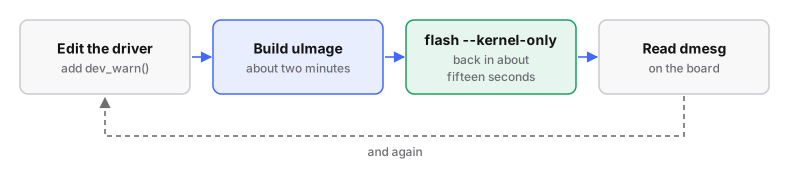
./devkit build builds the kernel with everything else; while iterating, build
it alone (about two minutes) and flash uImage alone: the board is back in
about fifteen seconds. A changed device tree goes with --dtb-only.
| Commands | |
|---|---|
build and flash uImage, either kernel |
change a kernel driver |
| build and flash the device tree, either kernel | change the device tree |
| Term | Meaning |
|---|---|
| the kernel | built as one file (uImage) |
| a driver | kernel code operating a device (the AD9361, the FPGA's capture and playback blocks) |
| the device tree | devicetree.dtb, compiled from a .dts: describes what hardware exists and where |
| a defconfig | a saved set of build options |
| cross-compiling | building on your PC for the board's ARM cores, hence ARCH=arm CROSS_COMPILE=… |
Not sure the kernel is where your change belongs? See using this board in your own project and lesson 23 of Fabric School.
Compiler. Either ARM Linux compiler builds both kernels and, through
./devkit build, U-Boot. On the factory target prefer
gcc-arm-linux-gnueabi: only it rebuilds the factory kernel byte for byte.
Building U-Boot by hand with gnueabihf needs
CC="arm-linux-gnueabihf-gcc -mfloat-abi=soft" (troubleshooting).
Buildroot's toolchain is needed only for the factory root filesystem.
Which kernel
firmware/ |
firmware-modern/ |
|
|---|---|---|
| Linux | 5.15.0, the vendor's fork of a fork | 6.12.0 LTS, Analog Devices' main |
| source appears at | firmware/src/linux (beside U-Boot and Buildroot) |
firmware-modern/src/linux (just the kernel) |
| created by | ./devkit setup --target factory |
./firmware-modern/setup.sh |
| device tree | arch/arm/boot/dts/zynq-pluto-sdr-fishball.dts, 1003 lines, flat |
arch/arm/boot/dts/xilinx/zynq-pluto-sdr-fishball.dts, 228 lines, an overlay on ADI's zynq-pluto-sdr.dtsi |
| defconfig | zynq_pluto_defconfig |
fishball_defconfig |
| patches | firmware/patches/, 18 of them |
firmware-modern/patches/, nine, drivers only |
Use firmware-modern/ unless you need the factory kernel: it is a current
LTS kernel with the transmitter-safety patches, tested on hardware.
firmware/ exists because the byte-identical factory claim only means
something against the factory kernel. Why 6.12 and not
mainline.
What is already patched
The full factory list, with a section on each, is
firmware/patches/README.md. Examples:
| Patch | Touches | Does |
|---|---|---|
0001-fishball7020-fixes.patch |
buildroot scripts | six upstream fixes; mints a persistent hw_serial on first boot |
0002-add-fishball-devicetree.patch |
arch/arm/boot/dts/ |
the board's device tree, as editable source |
0004-mute-tx-when-no-dma-stream.patch |
drivers/iio/adc/ad9361.*, drivers/iio/frequency/cf_axi_dds* |
mutes the transmitter whenever no DMA buffer streams |
0005-dont-clobber-a-gain-set-before-streaming.patch |
the same two drivers | stops the unmute overwriting a gain you set before starting (the smallest; read it first) |
firmware-modern/patches/ carries
0004, 0005, 0007, 0012, 0015, 0016, 0017 and 0018 rebased (six
add byte-identical code), plus 0019. 0019 fixes a case also present in 5.15:
ad9361_clear_state() memset the attenuation the kernel restores on unmute,
and 0 mdB (millidecibels) is full output, so a debugfs initialize followed by
any transmit stream keyed the transmitter at full power.
Kernel options
On firmware/, build_all.sh reapplies zynq_pluto_defconfig on every
full build, so menuconfig is a scratch edit; to keep it, edit the defconfig
(as a patch) or use make savedefconfig.
# run from: firmware/
make -C src/linux ARCH=arm CROSS_COMPILE=arm-linux-gnueabi- menuconfig
On firmware-modern/ the source is fishball_defconfig (CI checks it
round-trips through savedefconfig). Do not build zynq_pluto_defconfig
there: it is for an ADALM-Pluto and gives a kernel that boots cleanly with no
Ethernet and no SD card. firmware-modern/config/fishball.config explains the
26-option difference. On either board, zcat /proc/config.gz shows what the
running kernel was built with.
| Option | Why you would touch it |
|---|---|
CONFIG_AD9361 |
the transceiver driver: already y |
CONFIG_CF_AXI_ADC / CONFIG_CF_AXI_DDS |
capture and playback behind cf-ad9361-lpc and cf-ad9361-dds-core-lpc |
CONFIG_IIO_BUFFER / CONFIG_IIO_KFIFO_BUF |
the buffered-capture machinery every streaming tool needs |
CONFIG_DYNAMIC_DEBUG |
turns the drivers' dev_dbg messages on at runtime; off by default, and very useful |
CONFIG_FTRACE / CONFIG_KPROBES |
effectively off on both kernels: without CONFIG_FUNCTION_TRACER the only tracer is nop, though trace_marker works for userspace timestamps. Enable it for a debug build if printk is not enough |
Debugging a driver change
On the factory target (busybox) the points below apply; on
firmware-modern/ (Debian 13) pkill, full ps, gdb and anything you
apt install are available.
- No ftrace, no kprobes (both kernels). Use
dev_warn()plusdump_stack()and readdmesg; theComm:line names the process that called in, often the whole answer. - No
pkillon busybox. Usepsandkillwith a PID; apkillwith2>/dev/nullfails silently and leaves the process running. - An empty
dmesgis information: look in userspace, or in/mnt/jffs2(scripts there run at boot on Buildroot). /sys/kernel/debug/iio/iio:device0/exposes the AD9361's BIST (built-in self test), everyadi,*device-tree value, andcalib_mode.
Transmitter safety attributes
Settings the patched driver adds. All report what the radio actually holds.
| Attribute | Device | Default | What it does |
|---|---|---|---|
tx_starve_timeout_ms |
iio:device2 |
250 |
Mute if the DAC gets no data for this long. 0 disables. Values under 20 ms are refused: this board's network path delivers in bursts, and a shorter timeout would mute healthy streams. |
tx_cyclic_timeout_ms |
iio:device2 |
0 (off) in the driver, 60000 on this devkit's root filesystem |
Bound an unattended cyclic transmit, which otherwise repeats forever in hardware. fishball-rf-quiesce arms it at boot; fw_setenv tx_cyclic_bound <ms> changes it, 0 disables. |
tx_disable |
iio:device0 |
0 |
Latch maximum attenuation. Survives debugfs initialize, and blocks bist_tone mode 1. |
tx_temp_limit |
iio:device0 |
0 (off) |
Millidegrees C. Refuse to lower attenuation above this die temperature. |
tx_dma_underflow_count |
iio:device2 |
counter | the DAC ran out of data; any write resets it |
tx_dma_overflow_count |
iio:device2 |
counter | the DMA could not keep up; any write resets it |
# run from: the board
cd /sys/bus/iio/devices/iio:device2
cat tx_starve_timeout_ms tx_dma_underflow_count
echo 0 > tx_dma_underflow_count      # any write resets it
Why these exist: transmitter safety and
tools/IDLE-CASES.md.
Making it stick
Both src/ directories are regenerated by their setup.sh, so a change
survives only as a patch. Generate it against the applied tree, number it after
the existing ones, and add a CI assertion (every patch has one):
| target | patches go in | assertion goes in |
|---|---|---|
firmware/ |
firmware/patches/ |
.github/workflows/verify-patches.yml |
firmware-modern/ |
firmware-modern/patches/ |
.github/workflows/verify-modern.yml |
Never put a safety-relevant field in struct ad9361_rf_phy_state.
ad9361_clear_state() memsets it and debugfs initialize calls that, so
anything there can be cleared by the interface it defends against. Use
struct ad9361_rf_phy, and seed the field so that zero is not the dangerous
value.
The modern workflow also builds and audits the device tree
(firmware-modern/verify_dtb.py, 16 checks, because device-tree mistakes
usually build and boot) and cross-builds uImage, failing on a warning in any
patched file. Details: CONTRIBUTING.md.