Build the FM channelizer example
A worked example of your own DSP in the datapath: the optional patch
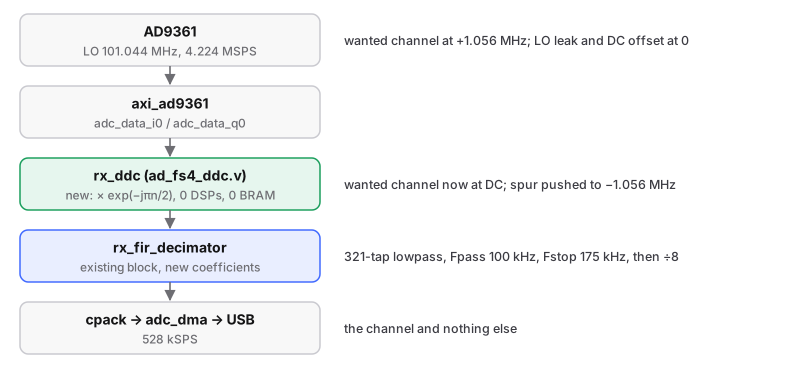
0003-wbfm-channelizer.patch makes the board deliver one 200 kHz FM
broadcast channel, every other station removed in the FPGA. It needs Vivado
2022.2 and a previous full factory build.
Build it
The default targets 102.1 MHz (Studio Brussel); the station is a runtime
setting (retuning). The coefficients and the
block-design change both need the FIR IP regenerated, and build_hdl.tcl reuses
an existing pluto.xpr, so delete the project first or the build silently
produces the old filter.
# run from: firmware/
./scripts/setup.sh          # if src/ does not exist yet
# --hdl-only reuses the kernel, U-Boot and rootfs from a previous FULL build
# and refuses to run without one - run a plain ./scripts/build_all.sh first.
(cd src && git apply ../patches/optional/0003-wbfm-channelizer.patch)
rm -rf src/hdl/projects/pluto/pluto.{xpr,cache,gen,hw,ip_user_files,runs,sim,srcs,sdk}
./scripts/build_all.sh --hdl-only     # ~20 min instead of 70
It is not applied by default because it narrows RX channel 0 to one broadcast
channel. Check before flashing output/ as usual:
# run from: firmware/
grep -A6 "^4. DSP" src/hdl/projects/pluto/utilization.rpt   # expect 96 / 220
grep -A3 "Design Timing Summary" src/hdl/projects/pluto/timing.rpt
Then flash it: ./devkit flash --target factory --boot-only
(put it on the board).
Delete the Vivado project before the rebuild
Without the rm -rf line above the build reuses the old project and
silently produces the old filter.
Run it
The second rate engages the filter: it drives GP_CONTROL bit 0, which
selects the filtered path through the bypass mux. Without it samples arrive
unfiltered.
# run from: the board
iio_attr -o -c ad9361-phy altvoltage0 frequency 101044000     # RX LO
iio_attr -i -c ad9361-phy voltage0 sampling_frequency 4224000 # converter rate
iio_attr -i -c ad9361-phy voltage0 rf_bandwidth 4000000       # analog LPF
iio_attr -i -c cf-ad9361-lpc voltage0 sampling_frequency 528000   # <- engages the FIR
- Read the converter rate back. Anything other than 4224000 puts the channel off-centre.
- Check the shifter is in the bitstream: the LO-leakage spur (always at 0 Hz on a zero-IF receiver) should appear at −1.056 MHz. Still at DC means the flashed bitstream lacks the change.
- A/B the filter: set
cf-ad9361-lpc voltage0 sampling_frequencyback to 4224000 to bypass it, then to 528000 again. With a 65 536-point transform:
| Filter bypassed | Filter engaged | |
|---|---|---|
| Out-of-band signal at −724 kHz | −66.5 dBFS, 37.8 dB over the floor | gone |
| Capture RMS | −49.2 dBFS | −78.6 dBFS |
| Peak sample | 23 LSB | 1 LSB |
rx_ddc (the shifter) sits ahead of the bypass mux, so an undecimated capture
from this build is frequency-shifted but unfiltered, not raw.
The GNU Radio flowgraph docs/grc/fishball_wbfm_rx.grc is untested on
hardware. It sets both rates from a Python snippet after initialisation,
because gr-iio does not know about the FPGA decimator. Treat it as a starting
point, and report in an issue or PR if you run it.
Why the channel is shifted first, the rate plan and the filter's performance: an FM channelizer in the FPGA.