Before you transmit
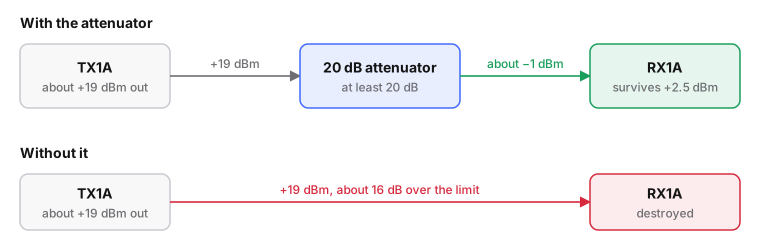
This board has a power amplifier: about +19 dBm out, against a receiver that survives +2.5 dBm.
| Rule | |
|---|---|
| 1. Put at least 20 dB of attenuation in any TX→RX loop | without it, the transmitter destroys its own receiver |
| 2. Terminate every transmit port, or leave it unused | never transmit at power into an open port |
| 3. No antenna on a transmit port you do not want radiating at power-on | every power-on emits a ~4 ms burst on both transmit ports, before any software runs |
| 4. Affirm the channel before raising it | ./devkit tx-guard affirm 0 for TX1A, 1 for TX2A, after looking at that port |
# run from: the repo root
./devkit tx-guard affirm 0        # only after LOOKING at TX1A
./devkit tx-guard revoke both     # withdraw, and force maximum attenuation
Writing your own transmit code? Two more rules apply: set the attenuation after the buffer starts and read it back, and mute before tearing the buffer down. Why, with the measurements: transmitter safety reference.
Next: use the radio: capture IQ or SDR++.