Faster streaming: what was tried
The question: can the board stream one receiver to a PC at about 20 MS/s,
enough for a live 20 MHz view in SDR++, instead of the 11 MS/s it manages
through iiod today? The answer is yes, with 8-bit samples. Three paths
that keep the radio's 16-bit samples were built and measured, and the best
sustains 12 MS/s. Sending 8 bits per I and Q instead, from
zc-stream
on two cores, reaches 20 MS/s, and 19 MS/s with margin. The patched SDR++ uses it as its
Fast TCP transport. This page
records what was measured, so nobody has to repeat it. To use it, see
stream 20 MS/s to SDR++.
- 16-bit paths: at most 11–12 MS/s: one ARM core at 100% copying samples into the network
- 8-bit
zc-stream -8, two cores: 19–20 MS/s; 19 MS/s when every sample counts - ceiling: the kernel's network send path, about 42.7 MB/s
- cost of 8 bits: about 48 dB visible dynamic range instead of 72 dB
- every number: measured over Wi-Fi, then again on a direct gigabit cable: the same limits (on a cable)
| Term | Meaning |
|---|---|
iiod |
the board's IIO server: the program SDR++, pyadi-iio, GNU Radio and MATLAB talk to over the network |
| DMA | the FPGA hardware that moves samples from the radio into the board's memory |
The result
Every path was measured the same way: RX2 only, the board on gigabit
Ethernet, the PC on Wi-Fi, 12 s per rate timed over seconds 3 to 12, and a
60 s run at the highest passing rate. "Sustained" means at least 99.5% of the
samples arrived over those 60 s.
tools/stream-paths/rx-rate.py
repeats any of it (--bps 2 for 8-bit samples).
| Path | Sustained RX2 | Highest rate seen | Board CPU at the limit | Works with today's apps |
|---|---|---|---|---|
Stock iiod 0.26, 16-bit |
11 MS/s (100% over 60 s; 12 MS/s gave 95.4%) | 44–46 MB/s | iiod at 90–100% of one core |
yes |
libiio 1.0 iiod, 16-bit |
11 MS/s (12 MS/s gave 97.5% over 60 s) | 48–50 MB/s | iiod at 100% of one core |
the 0.26 iio_attr and iio_readdev work against it unchanged; pyadi-iio and SDR++ use the same 0.26 library but were not tried |
zc-stream, raw TCP, 16-bit |
12 MS/s (99.9% over 60 s; 13 MS/s gave 96.7%) | 52–57 MB/s | zc-stream at 100% of one core |
SDR++'s Network Source, GNU Radio or a script; tuning stays in iiod |
zc-stream -8, raw TCP, 8-bit, two cores |
19–20 MS/s (19: 99.9%; 20: 99.7% over 60 s, but not every time, below) | 42.7 MB/s ≈ 21 MS/s | both cores: board 88%, zc-stream 175% |
the patched SDR++, with every control; Network Source; a script |
The 8-bit path was built up in steps, each measured the same way:
zc-stream -8 |
Sustained RX2 |
|---|---|
| one thread: wait for the DMA, convert, send | 17 MS/s (99.8%) |
| two threads: one converts while the other sends | 19 MS/s |
| two threads, the sender pinned to CPU1 | 20 MS/s (99.7% over 60 s) |
the same, sending with MSG_ZEROCOPY from the converted buffer |
no gain (~42 MB/s) |
At 20 MS/s the margin is thin, and Wi-Fi decides the rest
Later runs at 20 MS/s gave 99.7% over 45 s into SDR++, 99.8% over 33 s, and
98.8% and 95.1% over two 60 s runs. In the 98.8% run zc-stream used 120% of
the 200% available, so the board was keeping up. A sweep straight after gave
99.9% at 19 MS/s, 99.1% at 20 and 97.6% at 21. So 20 MS/s works, and 19 MS/s
is the rate to choose when every sample counts.
Block size matters for libiio. The 16-bit rows were measured with blocks
of 1 M samples. Each block is a request to iiod and back, so small blocks
cost rate:
| libiio block | 5 MS/s | 7.68 MS/s | 10 MS/s |
|---|---|---|---|
| 1/200 s (SDR++'s stock PlutoSDR source) | 96.5% | 83% | |
| 1/20 s (the patched SDR++) | 99.9% | 99.9% | in full |
For comparison, on the same board and network:
| Plain TCP from the board to the PC, no radio, from Python | 75 MB/s ≈ 19 MS/s at 16 bits |
Capture on the board itself (local:), no network |
30.72 MS/s with no loss |
| Gigabit Ethernet's own limit for one receiver | about 29 MS/s at 16 bits |
On a direct cable
The PC on the board's own Ethernet cable (an AX88179B USB 3 adapter on the
cdc_ncm driver, both ends linked at 1000 Mb/s full duplex), RX2 only,
2026-10-05. Same tool and method as above.
| Path | Sustained RX2, wired | Over Wi-Fi (above) |
|---|---|---|
Stock iiod 0.26, 16-bit |
12 MS/s (99.9% over 60 s; 13 MS/s gave 99.4%, 14 gave 93.3%) | 11 MS/s |
zc-stream -8, 8-bit |
20 MS/s (99.7% over 60 s; 21 MS/s gave 98.8%) | 19–20 MS/s |
Asked for more, zc-stream -8 levels off at 42–43 MB/s (about 21 MS/s),
exactly where it stopped over Wi-Fi, with zc-stream at 165% of the two
cores: Wi-Fi was never the limit, the board's CPU is. A wire buys iiod
one MS/s and steadier runs, not a higher ceiling.
The bare link, with no radio (iperf3, one TCP stream, 10–12 s):
| Direction | Rate | The board's CPU |
|---|---|---|
| board → PC | 577–679 Mb/s | core 0 at 86–87% |
| PC → board | 664–680 Mb/s | core 0 at 100%, all of it network interrupt work; the Ethernet controller counted 1680 receive overruns |
PC → board, receive work spread over both cores (rps_cpus = 3) |
702 Mb/s, retransmits 532 → 44 | core 0 still 100% |
Neither end takes jumbo frames: the board's macb driver stops at 1518 bytes
and the adapter under cdc_ncm at 1500. Setting up the cable itself:
a direct cable to your PC.
Why the 16-bit paths stop at 11–12 MS/s
The limit is the board's CPU copying samples into the network, not the network and not the radio. Every 16-bit path ends with one ARM Cortex-A9 core at 100% while the second core has little to do.
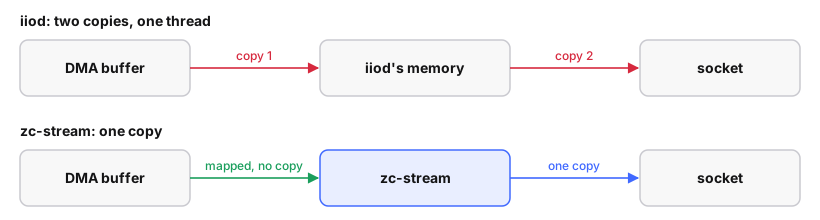
iiodcopies each sample twice: from the DMA buffer into its own memory, then into the socket. One thread does both.- libiio 1.0 keeps several blocks in flight and can hand DMA buffers around by reference (DMABUF, which the 6.12 kernel supports and 5.15 does not). But its zero-copy path is for USB only: over the network it still copies each block into the socket, and the extra threads did not spread that over both cores. Whether DMABUF was used at all could not be confirmed.
zc-streamreads the DMA blocks without copying (libiio maps them into the program) and copies once, into the socket. That buys one MS/s.- True zero-copy is not possible here. Asking Linux to send the DMA block
without copying it (
MSG_ZEROCOPY) fails withEFAULT: the network stack cannot pin the radio's DMA memory. Bigger blocks, more blocks in flight and a larger socket buffer madezc-streamslower, not faster.
How 8 bits get to 20 MS/s, and what stops them there
Half the bytes. The radio's samples are 12 bits, sent in 16. -8 keeps
the top 8 (a shift right by 4), so 20 MS/s is 40 MB/s instead of 80.
Both cores. One thread waits for each DMA block and converts it; a second sends the converted block, from a ring of four, while the first converts the next. The sender is pinned to CPU1, because every interrupt, the network's included, lands on CPU0. That last step was worth 1 MS/s.


The ceiling is the kernel's network send path, at about 42.7 MB/s:
- Reading the DMA memory is not it. Read on its own, a DMA block streams at 265 MB/s (236 MB/s copied), against 353/301 MB/s for normal memory: slower, because it is mapped uncached, but six times what 20 MS/s needs.
- With the radio taken out (
zc-streamsending numbered synthetic blocks), the stream still stops at about 42 MB/s. MSG_ZEROCOPYfrom the converted buffer, which is normal memory, works, but gains nothing: the copy was not the cost.
Open point
The plain-TCP test from Python above reached 75 MB/s on the same link, while the
synthetic C sender stops at 42. Neither the block size, the Wi-Fi on the day nor
the reader (nc here) has been ruled out. Rerun both back to back before quoting
either as the link's limit.
The cost is dynamic range: about 48 dB between the strongest and weakest signal visible at once, against 72 dB for 12 bits. Strong signals are unaffected; set the gain so the strongest one sits near the top, because the four bits dropped are where a weak signal lives. Decoding DAB+ through SDR++, the 8-bit path and libiio gave the same SNR (1.3 and 1.4 dB on a weak block).
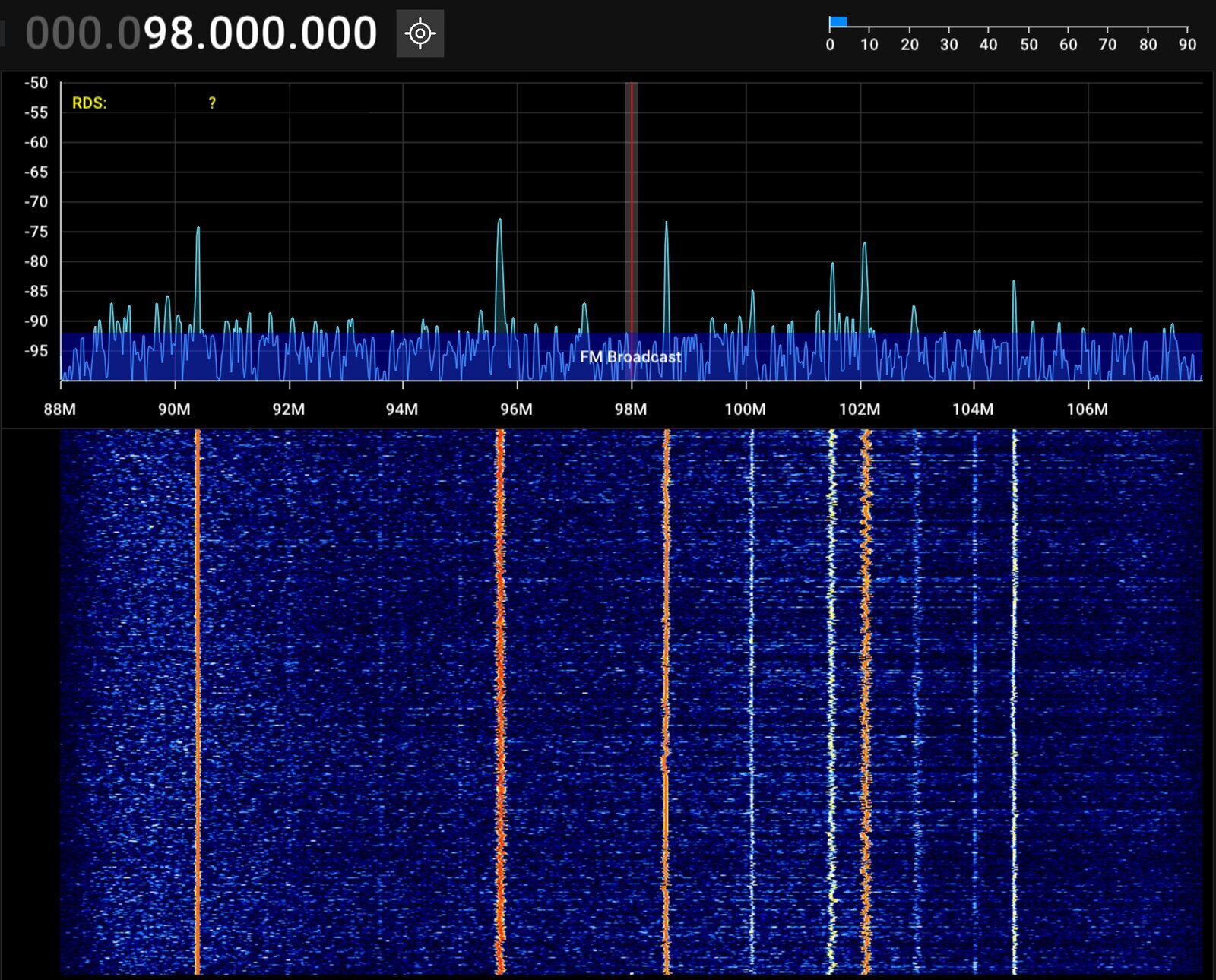
The patched SDR++'s PlutoSDR source at 20 MS/s on the Fast TCP transport: the whole FM band live, tuned and controlled from the source panel as usual.
What else works for more bandwidth
- Send fewer samples. The FPGA's ÷8 decimator filters in hardware and sends an eighth of the rate: up to 7.68 MS/s of clean bandwidth, well inside every limit here (SDR++). It works on the Fast TCP transport too.
- Process on the board. Code there reads 30.72 MS/s with
local:and can send only its results (your own project).
Using zc-stream
tools/stream-paths/zc-stream
has the commands. In short: install it on the board as a service, which runs
zc-stream -D -8 (RX1 on port 5555, RX2 on 5556, int8), and pick Transport:
Fast TCP in the patched SDR++'s PlutoSDR source
(how). Tuning, gain, rate and the
receiver stay in SDR++, which sets them through libiio.
One program receives at a time
The board has one receive buffer. libiio switches it off before opening it, so a
second program's attempt to stream used to stop the first one's stream even
though the attempt itself failed. zc-stream now refuses a client while someone
else streams, and rebuilds its buffer if a libiio program stops it. Measured both
ways with iio_readdev: the running stream carried on and the newcomer got
"Device or resource busy".
Not tried
- libiio 1.0 over USB. Its DMABUF zero-copy path is the USB one, and USB is where the board is weakest today (about 5 MS/s). The test build had it switched off. It is the one libiio 1.0 experiment that could pay off.
- A wired PC. Every number here crossed Wi-Fi. A cable would show whether 20 MS/s at 8 bits is steady without Wi-Fi's variation.
- Packing 12-bit samples (3 bytes per I/Q pair instead of 4): 25% less data with no loss of dynamic range, but at 16-bit rates the CPU, not the bytes, is the limit, so it would need the two-core pipeline as well.