Measure ten modulations
tools/modulation-gallery/ transmits ten modulations from the board, from a CW
tone to 64-QAM, OFDM and a LoRa-style chirp, captures each on a separate radio
and measures it.
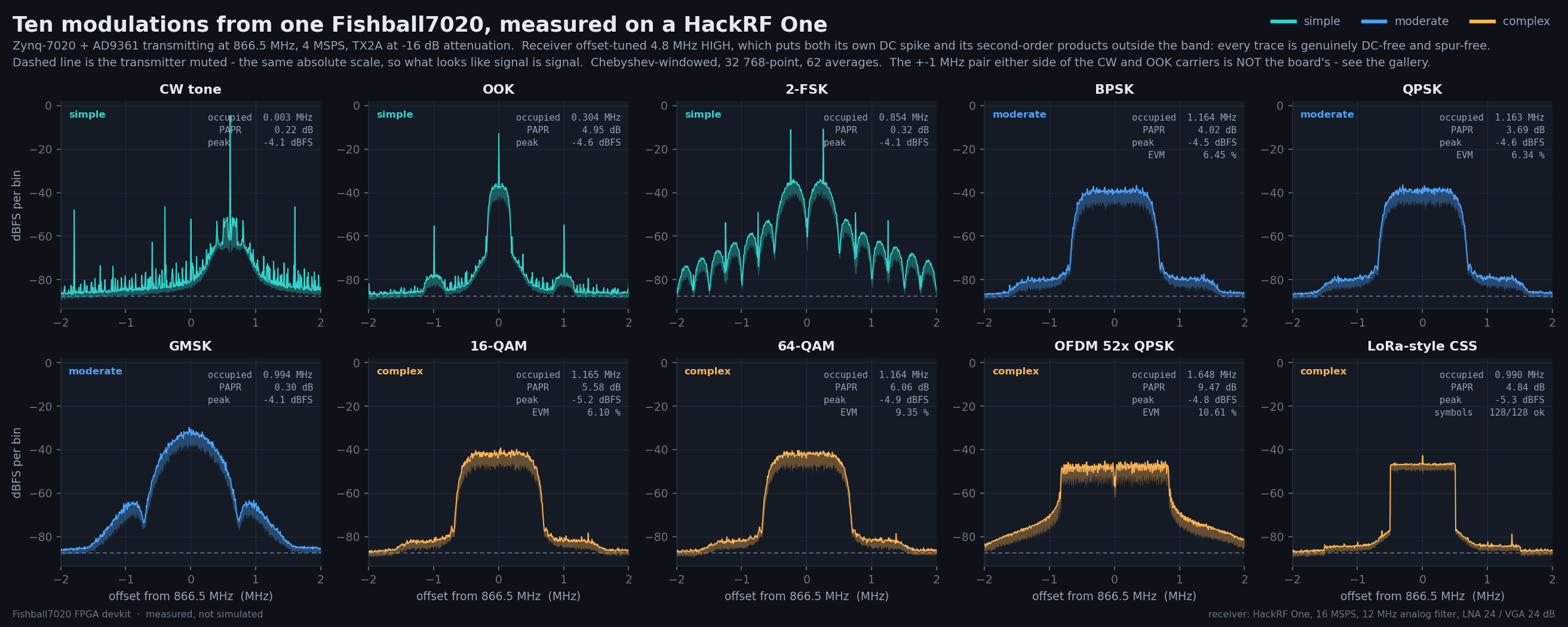
This transmits
866.5 MHz is inside the European ISM band and the levels are low, but the band has duty-cycle and power limits that differ by country; what leaves the antenna port is the operator's responsibility (see before you transmit).
# run from: tools/modulation-gallery/
python3 -m venv --system-site-packages .venv   # a venv that still sees the system's GNU Radio
.venv/bin/pip install numpy scipy matplotlib
.venv/bin/python campaign.py   # transmit each signal, capture it, measure it
.venv/bin/python fig1.py       # ... through fig5.py, redraw the figures
You need a HackRF (or any SoapySDR receiver, by editing hackrf_cap.py), GNU
Radio for the capture, and the board reachable over libiio. board.py takes the
board's address as its argument (changing the board's IP).
Every waveform comes from a fixed seed, so captures can be re-analysed without
transmitting again. The measurement chain is checked against known answers:
# run from: tools/modulation-gallery/
.venv/bin/python dsp.py          # spectrum calibration against known answers
.venv/bin/python waveforms.py    # every waveform normalised and cyclic-seamless
.venv/bin/python rx.py           # the demodulator, against a known synthetic channel
.venv/bin/python chain.py        # anti-alias filter, and what it does to an interferer
You should see: the captures measured, and fig1.py to fig5.py redrawing
the figures.
The results, and which spurs belong to the board: ten modulations, received on a HackRF One.