Receive on both channels
One command records RX1 and RX2 together, sample-aligned, in one file.
# run from: the repo root
tools/sigmf-capture.py record out --channels both --rate 3e6 --seconds 5 --verify
One file, core:num_channels: 2, interleaved RX1-I, RX1-Q, RX2-I, RX2-Q per
sample instant. --split writes two single-channel recordings instead.
| Good to know | |
|---|---|
| rate | 2 channels at 3 MSPS are clean; at 10 MSPS they drop samples |
| with the FPGA ÷8 decimator | both channels are filtered (patch 0021, applied by every build): at least 69.7 dB of alias suppression on channel 1 |
| IIO channel names | cf-ad9361-lpc input voltage0/1 = RX1 I/Q, voltage2/3 = RX2 I/Q; gain, rate and bandwidth live on ad9361-phy |
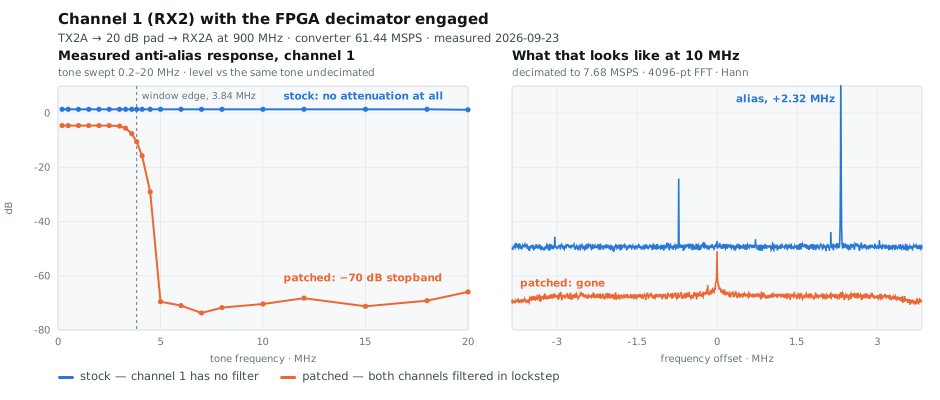
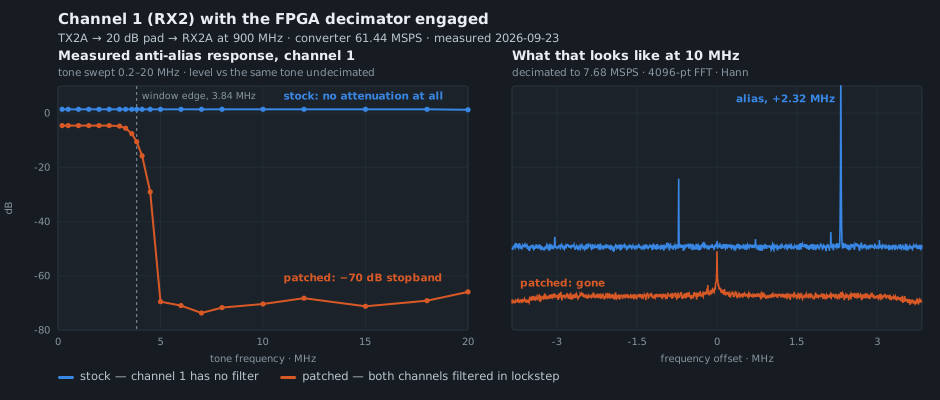
Channel 1 with the decimator engaged, before and after patch 0021.
Coherent, but not calibrated
Both receivers share one RX_LO, so their phase relationship is stable. The
analogue phase offset through baluns and traces is real, tens of degrees and
frequency-dependent: measure it with a splitter and matched cables before
trusting any angle.
Without the capture tool?
# run from: your host
iio_attr -u ip:192.168.2.1 -i -c cf-ad9361-lpc voltage0 sampling_frequency 7680000

# channel 0 is voltage0/voltage1, channel 1 is voltage2/voltage3
iio_readdev -u ip:192.168.2.1 -b 131072 -s 262144 cf-ad9361-lpc \
  voltage0 voltage1 voltage2 voltage3 > both.bin
More: capturing IQ · two receivers that both survive decimation.